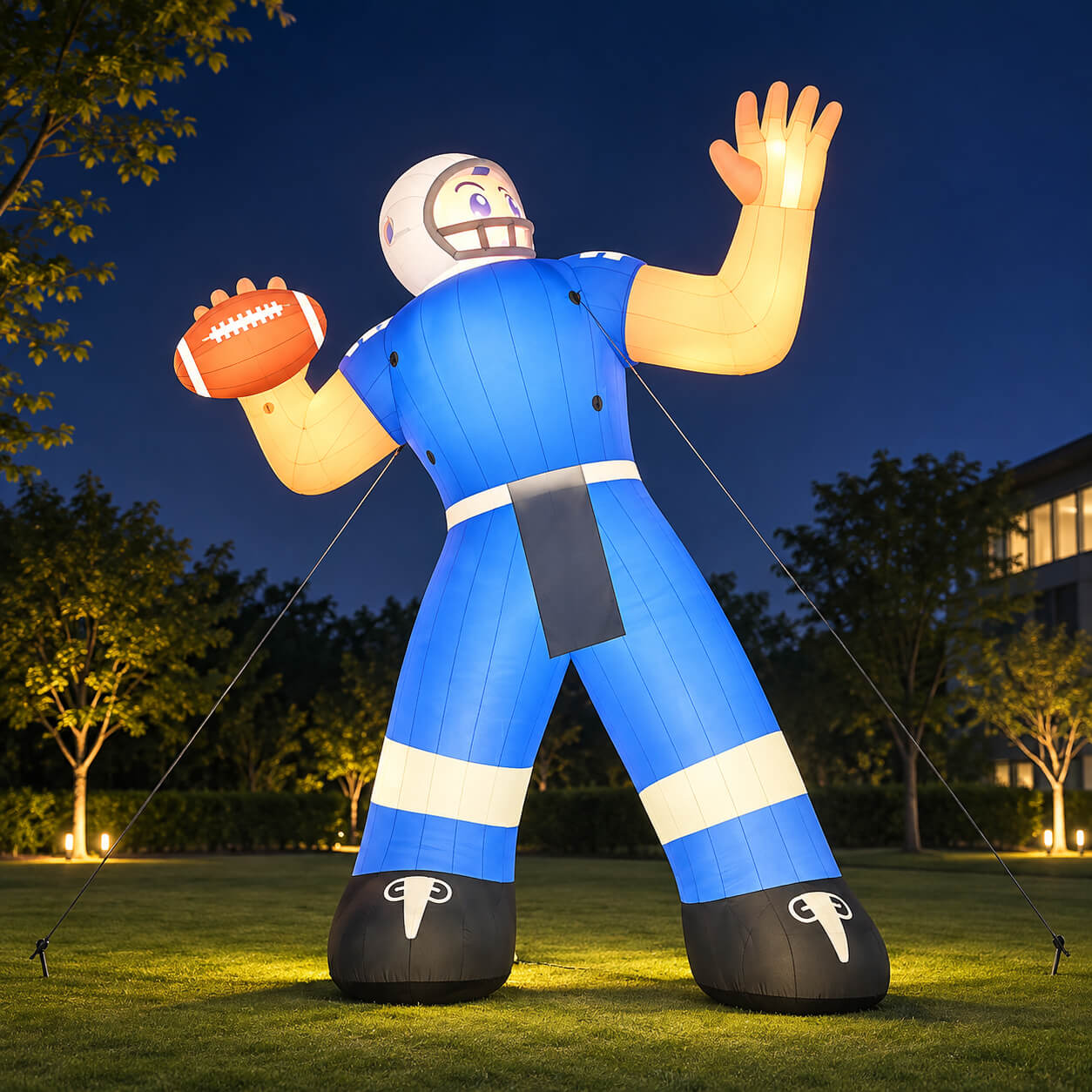
Why Ground Stakes Cannot Be Used on Modern Artificial Turf
Modern synthetic stadium fields rely on engineered drainage layers, shock pads, and turf backing that can be voided or permanently damaged by driven metal stakes. Because team entrance tunnels operate right at the field edge, anchoring must rely entirely on non-puncturing surface weights and stadium-approved attachment layouts.
During initial project evaluation, sharing your field surface type and available sideline depth allows D-ring placement and base-skirt weighting zones to be designed before fabrication.
Planning Non-Puncturing Ballast and Tether Geometry
Instead of stakes, turf deployments rely on distributed weighted ballast bags (filled with sand or water according to venue rules) attached to reinforced perimeter D-rings along both lower sidewalls and upper stabilization points.
- Keep all ballast weights, tether lines, blower housings, and extension cords strictly outside the interior player run-out corridor.
- Verify that base weights sit flat without sharp hardware that could abrade synthetic turf fibers during drag or deflation.
- Inspect tether tension, blower airflow, and local wind gusts continuously before and during match-day ceremonies.
Coordinating Egress, Power Feeds, and Weather Shutdown
No universal wind-speed rating applies across all custom tunnel silhouettes—tall mascot heads catch significantly more lateral airflow than low straight corridors. Facility managers must establish clear local weather stop criteria and keep stadium emergency exits completely unobstructed.
Pre-Quote Stadium Checklist
Send your sideline width, turf rules, desired passage height, and mascot or helmet reference so anchoring points can be planned into the structure from day one.